Sep 12, 2026Buying Guides
How to Evaluate a Spiral Plate Heat Exchanger Supplier in China: A Real Sourcing Case
How to Evaluate a Spiral Plate Heat Exchanger Supplier in China: A Real Sourcing Case
The difficult part is determining whether a supplier is actually capable of supporting your project.
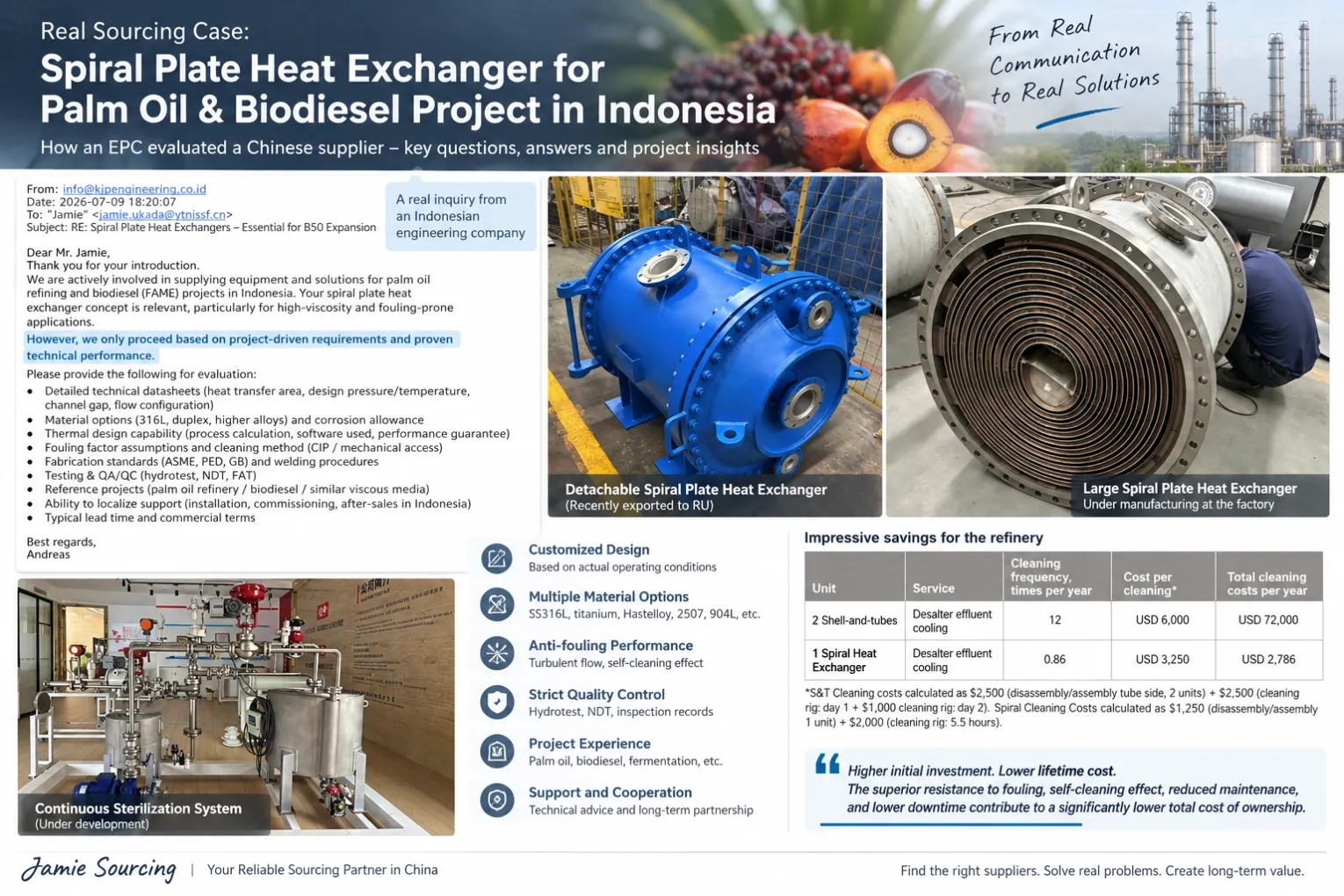
I learned this firsthand while working with a Chinese spiral plate heat exchanger manufacturer and communicating with an engineering company in Indonesia involved in palm oil refining and biodiesel (FAME) projects.
Instead of asking for a catalogue and price list, their engineer sent me a detailed list of questions covering thermal design, materials, fouling, cleaning, welding, testing, certification, project references and after-sales support.
I thought these questions were worth sharing.
If you are sourcing a spiral plate heat exchanger from China, this real case provides a useful checklist for evaluating potential suppliers.
I have also attached the actual manufacturer technical document used during this project at the end of this article for reference.
The Background: An Indonesian Palm Oil & Biodiesel Project
The customer was an engineering company serving palm oil refining and biodiesel projects in Indonesia.
They were particularly interested in three applications:
- Crude Palm Oil (CPO) heating and cooling
- FAME processing lines
- Waste heat recovery in refinery units
Spiral plate heat exchangers were interesting to them because some of these applications involve high-viscosity and fouling-prone media.
However, their position was very clear:
They would only proceed based on project requirements and proven technical performance.
Before considering cooperation, they wanted the manufacturer to answer a series of technical questions.
Here is what they asked — and what I learned from the process.
1. Can the Supplier Design According to Actual Operating Conditions?
The first request was for detailed technical information, including:
- Heat transfer area
- Design pressure
- Design temperature
- Channel gap
- Flow configuration
This sounds like a request for a datasheet, but there was an important issue:
A customized industrial heat exchanger cannot be properly selected from a catalogue alone.
The manufacturer first uses a Heat Exchanger Technical Parameters Table to collect the actual operating conditions.
This includes information such as the media, flow rate, inlet/outlet temperatures, pressure and other process parameters.
The engineering team then performs the calculation and proposes a suitable configuration.
This was my first takeaway from the case:
When sourcing a customized heat exchanger, don't start by asking “How much is a 50 m² unit?” Start with your operating conditions.
The manufacturer documentation I received also showed this process clearly: operating parameters are collected first, followed by calculation, preliminary drawings and finally approved production drawings.
2. What Materials Can the Manufacturer Actually Work With?
The customer then asked about:
Material options and corrosion allowance.
The manufacturer offered materials including:
- Q235B
- Q345R
- SS304
- SS316L
- Titanium
- Hastelloy
- Duplex 2507
- 904L
For stainless steel applications, they normally use around 3 mm plate thickness, while 4 mm may be considered for some more corrosive conditions.
But the important point is that corrosion resistance should not simply be judged by saying:
“We use SS316L.”
The actual material should be selected according to the medium and its corrosiveness.
This is especially important when sourcing equipment for palm oil, chemicals, fermentation, wastewater or other industrial processes.
3. How Does the Supplier Perform Thermal Design?
This was one of the more interesting questions from the customer:
What is your thermal design capability? What software do you use? Can you guarantee the performance?
The manufacturer's response was that its engineering approach relies heavily on empirical data accumulated from years of practical applications, combined with design calculations.
They also reserve a margin in the heat transfer area to help ensure reliable performance.
According to the technical documentation provided to me, their manufacturing capability includes:
Heat transfer area: up to 300 m²
Design pressure: up to 4 MPa
Design temperature: –100°C to 400°C
The technical team can also provide design calculations, drawings and factory delivery documentation depending on project requirements.
As a sourcing person, this is something I would pay attention to.
A factory being able to manufacture stainless steel equipment does not necessarily mean it can design a heat exchanger correctly.
Fabrication capability and thermal/process engineering capability are two different things.
4. How Does the Supplier Deal With Fouling?
For this Indonesian customer, fouling was particularly important.
They asked:
What fouling factor do you assume, and how can the heat exchanger be cleaned?
The manufacturer's answer was that different media require different empirical values.
For example, for some oil-to-oil heat transfer applications, their reference fouling factor is approximately:
0.0001–0.0002 m²·K/W
But this is not a universal number.
For a real project, the supplier needs to evaluate the actual medium and operating conditions.
This is an important point because I often see suppliers promote spiral heat exchangers simply as:
“Self-cleaning and never fouls.”
I would be careful with that claim.
The spiral flow path creates turbulence that can help reduce deposit accumulation, but this does not mean the equipment will never require cleaning.
For highly viscous, scaling, crystallizing or particle-containing media, cleaning still needs to be considered during equipment selection.
5. Should You Choose a Detachable Spiral Plate Heat Exchanger?
This was another useful lesson from the project.
The manufacturer has both non-detachable and detachable spiral plate heat exchangers.
The non-detachable design is generally intended for relatively clean fluids.
For media prone to:
- Scaling
- Particles
- Crystallization
- Heavy fouling
a detachable spiral plate heat exchanger can be considered because the unit can be opened to facilitate cleaning.
The manufacturer's documentation makes the same distinction between Type I non-detachable and Type II detachable designs.
This is also why I would not recommend selecting this type of equipment based only on price.
Two spiral heat exchangers may look similar from the outside while being designed for very different operating conditions.
[INSERT REAL PROJECT PHOTO – Detachable Spiral Plate Heat Exchanger]
Example of a detachable spiral plate heat exchanger manufactured for an overseas industrial project.
6. What Manufacturing and QC Documents Should You Ask For?
The Indonesian customer didn't stop at the product specification.
They also asked about:
- Welding procedures
- Hydrostatic testing
- NDT
- FAT
- Quality control
This is exactly what an industrial buyer should do.
According to the manufacturer's documentation, its production process covers raw material inspection, forming, welding, assembly, surface treatment and pressure testing.
Each unit follows a production process flow card, with inspection carried out during different manufacturing stages.
After fabrication, hydrostatic and leak tests are performed.
Depending on the project, additional testing can include:
- Strength Testing
- Penetrant Testing (PT)
- Radiographic Testing (RT)
- Positive Material Identification (PMI)
The factory can also provide delivery documentation such as:
- As-built drawings
- Material quality certificates
- Manufacturing and inspection records
- Hydrostatic pressure test report
- Product certificate of conformity
For me, these documents are much more useful for evaluating a supplier than a beautifully designed company brochure.
[INSERT FACTORY / PRESSURE TEST PHOTO]
7. Never Assume the Supplier Has the Certification You Need
The customer also asked about:
PED, GB and ASME.
This is where transparency becomes important.
The manufacturer can work with Chinese pressure vessel standards and European PED-related requirements.
However, the factory does not currently hold ASME certification.
For projects requiring ASME, they stated that design and calculation documentation can be prepared according to ASME Code requirements at additional cost, with the customer working with the appropriate local inspection body.
Their technical document similarly states that PED/CE and EAC requirements can be handled on a project basis, while the factory does not currently hold ASME certification.
I think this is actually a good example of supplier evaluation.
A sourcing agent's job should not be to tell a buyer:
“Yes, everything is possible.”
The buyer needs to know what the factory can do, what it cannot do, and what needs to be handled separately before placing the order.
8. Ask for Real Projects, Not Just a Customer Logo Page
The customer naturally asked for:
Reference projects in palm oil refining, biodiesel or similar viscous-media applications.
The manufacturer had experience supplying spiral plate heat exchangers across biotechnology, oils & fats engineering, pharmaceuticals, new materials and overseas industrial projects.
The reference document provided to me includes actual projects and delivery records rather than simply displaying customer logos.
For sourcing industrial equipment, I normally prefer evidence such as:
Purchase records → manufacturing photos → inspection records → finished equipment → shipping/delivery evidence
rather than a slide containing 20 famous logos.
Of course, customer confidentiality should always be respected.
9. What Happens If There Is an After-Sales Problem?
This was one of the most practical questions in the entire discussion.
The customer asked whether the supplier could provide:
Installation, commissioning and after-sales support in Indonesia.
The reality was that the manufacturer did not have a local installation team in Indonesia.
Installation is normally handled by the end user, while the manufacturer can provide remote technical guidance.
The standard warranty offered was:
One year after acceptance or 18 months after delivery.
There was also a real overseas after-sales case that I found particularly useful.
In one project in Romania, a problem occurred with a spiral wound heat exchanger.
The manufacturer sent personnel to investigate the problem on site.
They eventually found that the process medium contained sand and sediment that had not been communicated during the earlier technical discussions.
This caused significant wear during operation.
The supplier then arranged local repair and recommended changing the heat exchanger configuration based on the actual operating conditions.
This case reinforced something I learned during my earlier project management work:
Many quality problems are not purely manufacturing problems. Sometimes the real problem starts much earlier — when the operating conditions are not fully communicated.
That is why collecting accurate technical information before production is so important.
10. Spiral Plate vs Shell-and-Tube: Don't Compare Purchase Price Alone
Finally, the customer asked whether the spiral plate heat exchanger could demonstrate:
A clear lifecycle cost advantage versus conventional shell-and-tube heat exchangers.
This is the right way to look at the question.
A spiral plate heat exchanger may have a higher initial investment in some applications.
But the real comparison should include:
Purchase cost + cleaning frequency + cleaning cost + maintenance + downtime + energy efficiency + equipment lifetime
For a fouling-prone process, the cheapest heat exchanger on the purchase order may not necessarily be the cheapest equipment to operate over several years.
So instead of asking only:
“Which heat exchanger is cheaper?”
I would ask:
“Which design gives the lower total cost under my actual operating conditions?”
[INSERT LIFECYCLE COST / CLEANING COMPARISON]
Lifecycle cost comparison should always be evaluated against the actual process conditions, cleaning frequency and operating history.
What I Learned From This Sourcing Case
This was a useful project for me because the buyer's questions went far beyond price.
They evaluated:
Process conditions → thermal design → material → fouling → cleaning → manufacturing → welding → testing → certification → references → after-sales → lifecycle cost
And this is how I believe industrial sourcing should be done.
When I worked as a project manager earlier in my career, I learned that many problems appearing at the end of a project actually started much earlier.
A missing process parameter.
An assumption that was never confirmed.
A certification requirement discovered too late.
A material specification that was not clearly communicated.
Finding a Chinese supplier is relatively easy.
Making sure the supplier is suitable for your actual project is the difficult part.
That is the part of sourcing I am most interested in.
Sourcing Spiral Plate Heat Exchangers from China?
If you are looking for a spiral plate heat exchanger manufacturer in China, you can send me your application and operating conditions.
I can help communicate with manufacturers, compare technical proposals, verify suppliers, follow up drawings and production, and coordinate inspection and shipment.
And if I don't think a supplier or solution is suitable for your project, I would rather tell you that before an order is placed.
Jamie Jiang
Jamie Sourcing
China Sourcing & Project Support
Technical Reference
For buyers who want to go deeper into the manufacturing capability, QC process, testing, standards and previous projects discussed in this case, I have included the actual technical document used during the supplier evaluation below.