
Buying Guides
How to Source a CNC Tube Bending Machine from China Without Choosing the Wrong One
A practical guide to sourcing CNC tube bending machines from China, covering key specifications, tooling, supplier selection, and common purchasing mistakes.
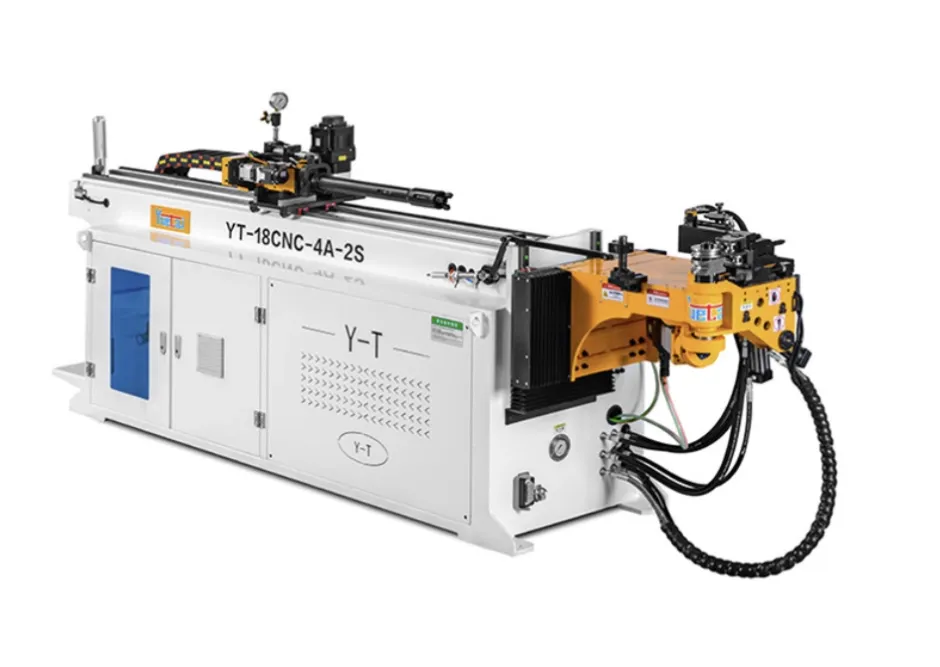
If you are looking for a CNC tube bending machine supplier in China, you will probably run into the same problem:
There are dozens of suppliers, hundreds of machine models, and long specification sheets. How do you know which machine is actually right for your production?
Most buyers start with the maximum tube diameter.
For example, if you need to bend a 38 mm stainless steel tube, you may start looking for a CNC tube bending machine that can handle 38 mm.
That makes sense as a starting point. But tube diameter alone is not enough to select the right machine.
Two tubes with the same outside diameter can require very different machines and tooling depending on the wall thickness, material, bending radius, and part geometry.
That is why we usually recommend starting with the part you need to manufacture, not the machine model.
What Information Should You Prepare Before Requesting a Quote?
If you simply ask a Chinese supplier:
You will probably receive a quotation very quickly.
But that does not necessarily mean the quoted machine is suitable for your application.
Before requesting a quote, it is better to prepare the following information:
- Tube outside diameter (OD)
- Wall thickness
- Material, such as stainless steel, carbon steel, aluminum, or copper
- Centerline radius (CLR)
- Bending angle
- Number of bends per part
- Product drawing or 3D file
- Tolerance requirements
- Expected daily or monthly production volume
If you already have a drawing, send it to the manufacturer for technical evaluation.
The real question is not:
"Which machine can bend a 38 mm tube?"
It is:
"Which machine can reliably produce this specific part?"
That difference matters when sourcing industrial machinery.
Why Can Two 38 mm Tubes Require Different Machines?
Consider two projects.
Customer A needs to bend a 38 mm carbon steel tube with a relatively thick wall, a large bending radius, and simple geometry.
Customer B also uses a 38 mm tube, but it is thin-wall stainless steel with a tight bending radius and several bends in different directions.
Both buyers may search for a "38 mm CNC tube bending machine," but the machine and tooling requirements can be very different.
Thin-wall tubes and tight bending radii are generally more demanding.
If the machine, tooling, and process are not properly matched, you may encounter problems such as:
- Wrinkling
- Tube flattening or excessive ovality
- Wall thinning
- Springback
- Cracking around the bend
This is why comparing machines only by maximum tube diameter and price can be misleading.
Similar specifications on paper do not always mean similar results on the factory floor.
Don't Forget the Tooling
This is one of the easiest things to overlook when sourcing a tube bending machine from China.
Buying a CNC tube bender does not mean the machine can automatically handle every tube size and geometry.
Depending on the application, the tooling setup may include:
- Bend die
- Clamp die
- Pressure die
- Mandrel
- Wiper die
Tooling becomes particularly important when you are working with:
- Thin-wall tubes
- Tight bending radii
- Stainless steel
- Multiple bends in one part
- Parts with higher appearance requirements
So when comparing quotations from Chinese CNC tube bending machine manufacturers, always check exactly what is included.
A lower quotation may cover only the basic machine.
Later, you may discover that additional tooling, mandrels, software, feeding systems, or other options are required.
At that point, the "cheapest machine" may no longer be the cheapest option.
Are More CNC Axes Always Better?
Not necessarily.
If you are producing relatively simple parts in small quantities, there may be little reason to invest in a highly automated multi-axis CNC machine.
For high-volume production, however, the situation is different.
Automatic feeding, rotation, bending, and unloading can reduce manual work and improve production consistency.
In industries such as automotive components, furniture, fitness equipment, heat exchangers, and other high-volume tube applications, the complete production process may include:
Tube Cutting → Bending → End Forming → Chamfering → Deburring
In these cases, it may make more sense to evaluate a complete tube processing line rather than purchasing several independent machines.
The right level of automation should be based on your actual production requirements—not simply on how many axes a machine has.
How Should You Compare CNC Tube Bending Machine Prices?
Suppose you receive three quotations from China:
Supplier A: USD 18,000
Supplier B: USD 25,000
Supplier C: USD 32,000
It is tempting to start with Supplier A.
But first, make sure all three suppliers are actually quoting comparable solutions.
We normally compare factors such as:
Machine capacity, CNC axes, servo system, tooling included, mandrel configuration, feeding system, software, electrical components, installation and commissioning, spare parts, warranty, and after-sales support.
For more complicated parts, another important question is whether the manufacturer can perform a bending trial based on your actual drawing.
For industrial machinery, we would rather see a supplier demonstrate:
"We can make this part."
than simply say:
"Our machine can bend tubes up to 50 mm."
How We Source CNC Tube Bending Machines in China
For this type of industrial sourcing project, we normally do not start with a machine model.
We start by understanding what the buyer needs to manufacture.
If you already have a product design, you can provide:
Drawing + Tube Size + Material + Wall Thickness + Production Volume
If you do not have a complete technical drawing yet, product photos, dimensions, and basic processing requirements can also help with the initial evaluation.
From there, we can identify suitable CNC tube bending machine manufacturers in China and work through the project step by step:
Machine Selection → Capacity Verification → Tooling → CNC Configuration → Automation → Sample Bending → Final Quotation
If your project requires more than bending, we can also evaluate related equipment for tube cutting, end forming, chamfering, and deburring.
It takes a little more work than simply asking for a machine price.
But it helps avoid a much more expensive problem:
Receiving the machine at your factory and then discovering that it cannot reliably produce your actual part.
Send the Drawing Before Asking for the Lowest Price
If this is your first time sourcing a CNC tube bending machine from China, one simple rule can save a lot of trouble:
Don't just send suppliers the machine specifications. Send them the part you need to manufacture.
A capable manufacturer should be able to review your application and recommend a suitable machine and tooling configuration—not simply send you a catalogue.
If you are sourcing a CNC tube bending machine, tube processing equipment, or a complete tube processing line from China, send us your drawing and production requirements.
We can help identify suitable Chinese manufacturers, review technical configurations, compare quotations, and clarify what is included before you place an order.
First make sure the machine can make your part. Then compare the price.