Sep 19, 2026Buying Guides
Handheld Cordless Vacuum OEM/ODM in China: What Buyers Should Really Check
Learn how to source handheld cordless vacuums from China, compare OEM/ODM suppliers, check product quality, and avoid common sourcing risks.
Search on Alibaba or other B2B platforms and you can quickly find hundreds of products. Many of them look similar, with similar specifications and prices.
The real challenge is:
How do you know which product and supplier are actually suitable for bulk orders and long-term cooperation?
From a sourcing perspective, I think there are two things buyers should pay particular attention to.
1. The Sample Is Good — But Will Mass Production Be the Same?
This is an important issue when sourcing small electrical appliances such as cordless vacuums.
You may receive a good sample with strong suction and decent battery life. Everything looks fine during testing.
But the real question is:
When you order 1,000 or 5,000 units, will the mass-produced products use the same key components and deliver the same performance?
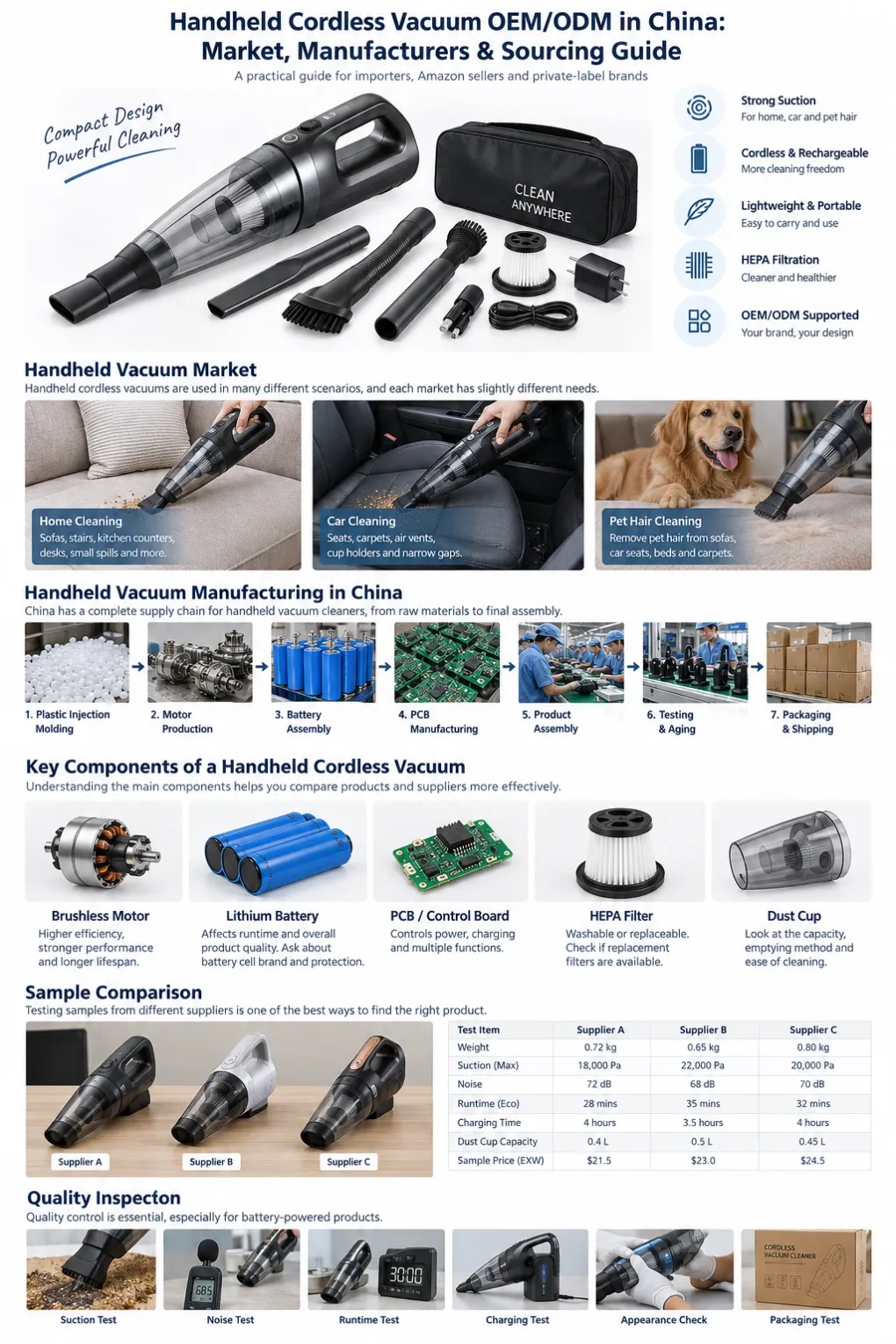
For a cordless vacuum, changes in the battery cells, motor, PCB, filter, or even some plastic parts can affect the final product.
Before placing an order, it is worth confirming:
- What motor is used?
- What battery cells are used?
- What is the actual runtime?
- Can the same key components be guaranteed for mass production?
- What QC and aging tests are performed before shipment?
For larger orders, it is also useful to keep the final approved sample as a Golden Sample.
This can be used as a reference during production and final inspection.
2. Don't Compare Suppliers Only by the Numbers
This is another common problem.
Supplier A says:
20,000 Pa
Supplier B says:
25,000 Pa
Supplier C says:
30,000 Pa
It is easy to assume Supplier C has the best product.
But these numbers don't always tell the full story.
Different factories may use different testing methods. Actual cleaning performance also depends on the motor, airflow design, sealing, filter, and nozzle.
Battery runtime is similar.
A supplier may advertise:
“Up to 40 minutes runtime.”
But this could mean 40 minutes at the lowest power setting, while the runtime at maximum suction may be much shorter.
So, whenever possible, we recommend putting samples from several suppliers on the same table and testing them under similar conditions.
Compare the things a real customer will actually notice:
- Suction
- Noise
- Weight
- Battery runtime
- Charging time
- Plastic quality
- Dust cup design
- Filter
- Accessories
Sometimes the product with the best specification sheet is not the product you would choose after actually using it.
Handheld Cordless Vacuum Supply Chain in China
China already has a mature supply chain for cordless vacuum cleaners.
Manufacturers and component suppliers are mainly concentrated in Jiangsu, Zhejiang, and Guangdong, covering motors, batteries, PCBs, plastic injection molding, filters, accessories, and final assembly.
For overseas buyers, this means there are plenty of choices.
But more choices also mean more comparison.
Some suppliers have their own R&D and manufacturing capabilities.
Some purchase key components such as motors, batteries, and PCBs from other factories and focus on final assembly.
Others are trading companies offering products from several different manufacturers.
A trading company is not necessarily bad, and being a factory does not automatically mean the supplier is better.
What really matters is understanding:
Who is actually making your product, and who can really control its quality?
OEM or ODM?
If you are testing a new market, I normally recommend starting with OEM.
You can select an existing, mature product and customize:
- Logo
- Color
- Packaging
- User manual
- Accessories
This keeps your initial investment, development time, and MOQ relatively manageable.
Once the product starts selling and you receive real customer feedback, ODM becomes more meaningful.
For example, your customers may tell you:
- They want longer battery life
- The vacuum is too noisy
- They need a larger dust cup
- They want better pet hair cleaning
- They need different accessories
At this point, you have a real reason to modify the product.
It is usually better than spending a large amount of money developing a different product simply because you want it to look different.